PHP Podcast – October 15, 2026
Hosts: Joe Ferguson & Holly Schilling
Sara abandoned Holly and Joe. Longhorn PHP kicks off, agentic commerce gets scary, bots keep scanning, and a Cold War satellite schematic proves software is harder than hardware.
Swag, Longhorn PHP, and “Am I Even a PHP Developer?”
Joe opened by confessing he found a JavaScript bug in the swag store cart while ordering socks and a hoodie — the curse of being a developer who can only ever see the bugs. Holly joked that Sara got bumped from the show for refusing to wear swag, while Eric apparently bought one of everything in the store, including a Peanuts-style team picture card from PHP Tech.
The conversation turned to Longhorn PHP 2026, which kicked off with a tutorial day and runs through the main talk day on Friday. Holly is presenting remotely after travel plans fell through, giving a talk on her pet peeve: websites that get “packaged up” and shipped as apps instead of being built as real native applications.
That led into a heartfelt riff on imposter syndrome. Holly admitted she’s spent years insisting she’s “not really a PHP developer” despite submitting RFCs, speaking at conferences, and having an elephpant named after her. Joe shared his own years at a Python startup where he felt like a fraud for only writing PHP nights and weekends. The takeaway: showing up in community spaces — Discord, social media, GitHub, conferences — is all it takes to belong.
Agentic Commerce and Single-Use Card Security
Joe highlighted a Community Corner episode with Scott Keck-Warren and Paul Conroy on agentic commerce — the slightly terrifying idea of your Claude agent going out shopping on your behalf. Holly was especially wary of trusting Gemini for shopping advice given Google’s long history of steering how people search and buy.
Much of the underlying tech, they noted, lives in Stripe and resembles Apple Pay-style single-use card numbers: time-limited, amount-limited tokens that protect the real source card. Holly drew on her experience at a buy-now-pay-later company (now branded FlexPay) doing one-time code generation, where even 15-minute-lived card numbers required full PCI compliance, certificate pinning, HMAC, encryption at rest, and constant audits across every layer from mobile SDK to backend.
Bots, Scrapers, and Cloudflare to the Rescue
A Discord listener (ducknizzle) asked what everyone uses to kill bot and scanner traffic on public sites. Joe’s pessimistic answer: block ranges, sometimes entire countries, and ultimately just put it behind Cloudflare and let specialists deal with it — the same way you’d pay someone to host email rather than running it yourself.
Holly praised Cloudflare Pages for static content, calling it free and “it just works” with zero bandwidth worries, though WordPress makes things more complicated. Joe talked about his work-in-progress effort to standardize robots.txt across php.net properties, while acknowledging it only helps the well-behaved crawlers — malicious scrapers and AI training bots will simply ignore it. Holly estimated AI scrapers now outnumber legitimate bots roughly 10 to 1, and both lamented how the internet has lost some of its earlier friendliness.
How the PHP Security Team Handles Your Reports
Joe showcased a PHP Foundation blog post describing how the security team triages reports, sharing insight from his new role as a release manager. Release managers get advance heads-up on security releases, which follow extra processes to handle disclosures responsibly.
He explained that every report is read, triaged, and prioritized — someone in Discord recently got confirmation their advisory was “in the backlog.” The sobering reality is that the greater PHP security team is only one or two humans, reflecting the open-source nature of the project. The team can now issue its own CVEs rather than waiting on GitHub, so fixes and packager updates can ship as fast as possible. Joe noted serious, wild remote-code-execution-level vulnerabilities remain rare, especially this early in the 8.6 cycle, which just branched from master.
New PHP News Site, Design, and php.net’s Redesign
Joe demoed a new PHP ecosystem news site from Eric Barnes (Laravel News) and Matt Stauffer (Titan) in collaboration with the PHP Foundation — a modern aggregator reminiscent of the old Planet PHP days, complete with RFC coverage, a newsletter, topic sections, and a slick automatic dark mode toggle. Holly, admitting she has no eye for design herself, loved how well it was executed.
That sparked a running theme of developer respect for design as a discipline neither host feels competent in. Joe mentioned a php.net redesign in progress — mock-ups are available in the PHPC Discord’s PHP Foundation Ambassador Marketing subgroup, though it’s still a work in progress and not yet mobile friendly. Both admitted feeling like outsiders in design meetings the way non-developers feel in dev meetings. Joe shared Anthropic’s guidance to tell Claude what you *don’t* want for front-end work, to which he replied that as a developer, he often doesn’t even know what he doesn’t want.
A Satellite Schematic vs. a Million Lines of Code
Holly launched into a favorite tangent, inspired by Apple releasing its home hub device years after the hardware was ready and pundits asking why the software took so long. Working on her own project with 16 encryption keys across five servers, she had to draw diagrams just to keep the key exchanges straight.
She then described a treasured artifact: a 3-by-9-foot schematic of an entire FSC-78 Bravo-mod satellite terminal from her Army SATCOM days at Fort Detrich — the whole Cold War-grade, anti-jamming system fitting on roughly 65 letter-sized pages. Contrast that with Margaret Hamilton’s famous photo beside the Apollo code printouts: around a million lines, a scale that’s routine in modern projects. Her point: software complexity dwarfs even elaborate hardware, and developers rarely give themselves credit for it — leaky abstractions, uncaught exceptions, and endless edge cases don’t plague hardware the way they plague code.
The discussion wrapped with fault tolerance stories: Joe discovered a three-node Elasticsearch staging cluster where failover had never been enabled (and only one node was taking all the traffic), and Holly recalled a satellite timing setup with redundant cesium sources where the only part that kept failing monthly was the single non-redundant box joining them together. Fault tolerance, they agreed, is important.
Links from the show:
PHP Tech 2027 — Chicago, April 27–29, tickets & CFP open
Join us in Discord
PHP Arch Swag Store
PHP Foundation — How the Security Team Handles Your Reports
Community Corner Podcast: Agentic Commerce with Paul Conroy
2027 State of Open Source Survey (Perforce / OpenLogic / Zend)
PHP Architect Consulting
Host:
Joe Ferguson
Mastodon: @[email protected]
PHPArch.me: @svpernova09
Sara Golemon
Mastodon: @[email protected]
Holly Schilling
Mastodon: @[email protected]
Streams:
Youtube Channel
Twitch
Connect & Hire
PHP Architect Website
Twitter/X
Mastodon
Hire PHP Developers
Looking to hire PHP developers? Email [email protected] – Joe and the team are available for consulting, infrastructure work, Ansible playbooks, and code review.
Partner
This podcast is made a little better thanks to our partners
OurCVEs
Your security posture, on autopilot with OurCVEs
CodeRabbit
Cut code review time & bugs in half instantly with CodeRabbit.
PHP Architect Consulting
Your PHP codebase deserves a partner, not a contractor. PHP Architect provides long-term technical partnerships for organizations that need senior-level PHP expertise that you can depend on. Learn more.
Music Provided by Epidemic Sound
https://www.epidemicsound.com/
Join Us Live Next Week
Youtube Channel
Got feedback? Join us on Discord at discord.phparch.com
The post The PHP Podcast 2026.10.15 appeared first on PHP Architect.
Oct 15, 2026
Community Corner Podcast: Agentic Commerce with Paul Conroy
In this episode, Scott talks with Paul Conroy about agentic commerce: how AI agents buy things on our behalf, how Stripe’s shared payment tokens keep them on a budget, and how the Machine Payments Protocol finally puts HTTP 402 Payment Required to work in your API middleware.
Links:
Our Discord – https://discord.gg/aMTxunVx
Buy our shirts – https://store.phparch.com/products/community-corner-podcast-t-shirt
Mentioned in this episode:
Charging AI Agents Per Request: A Practical Guide to the Machine Payments Protocol – https://conroyp.com/articles/practical-guide-machine-payments-protocol
Agentic Commerce Beyond The Checkout: Building with Machine Payments (Paul’s talk) – https://conroyp.com/speaking/agentic-commerce-beyond-the-checkout-building-with-machine-payments
PayForGoals.com, the MPP demo – https://payforgoals.com
PayForGoals.com source code – https://github.com/square1-io/www.payforgoals.com
laravel-mpp package – https://github.com/square1-io/laravel-mpp
Stripe Machine Payments Protocol quickstart – https://docs.stripe.com/payments/machine/mpp/quickstart
Paul’s Links:
Website – https://conroyp.com
Company: Square1 – https://square1.io
X / Twitter – https://x.com/conroyp
Bluesky – https://bsky.app/profile/conroyp.bsky.social
LinkedIn – https://www.linkedin.com/in/paulconroy2/
GitHub – https://github.com/conroyp
Scott’s Links:
Website – https://scott.keck-warren.com/
Bluesky – https://bsky.app/profile/scottkeckwarren.bsky.social
LinkedIn – https://www.linkedin.com/in/scott-keck-warren-91689810/
Mastodon – https://phpc.social/@scottkeckwarren
PHP Architect Social Media:
X: https://x.com/phparch
Mastodon: https://phparch.social/@phparch
Bluesky: https://bsky.app/profile/phparch.com
Discord: https://discord.phparch.com
Subscribe to our magazine: https://www.phparch.com/subscribe/
Partners
This podcast is made a little better thanks to our partners.
OurCVEs
Your security posture, on autopilot with OurCVEs
CodeRabbit
Cut code review time & bugs in half instantly with CodeRabbit.
PHP Architect Consulting
Your PHP codebase deserves a partner, not a contractor
PHP Architect provides long-term technical partnerships for organizations that need senior-level PHP expertise that you can depend on
https://www.phparch.com/consulting/
Music provided by Epidemic Sound https://www.epidemicsound.com/
The post Community Corner Podcast: Agentic Commerce with Paul Conroy appeared first on PHP Architect.
Oct 15, 2026
·
21m 6s
By golly if I'm not all in on Opus
Oct 13, 2026
·
1h 23m 38s
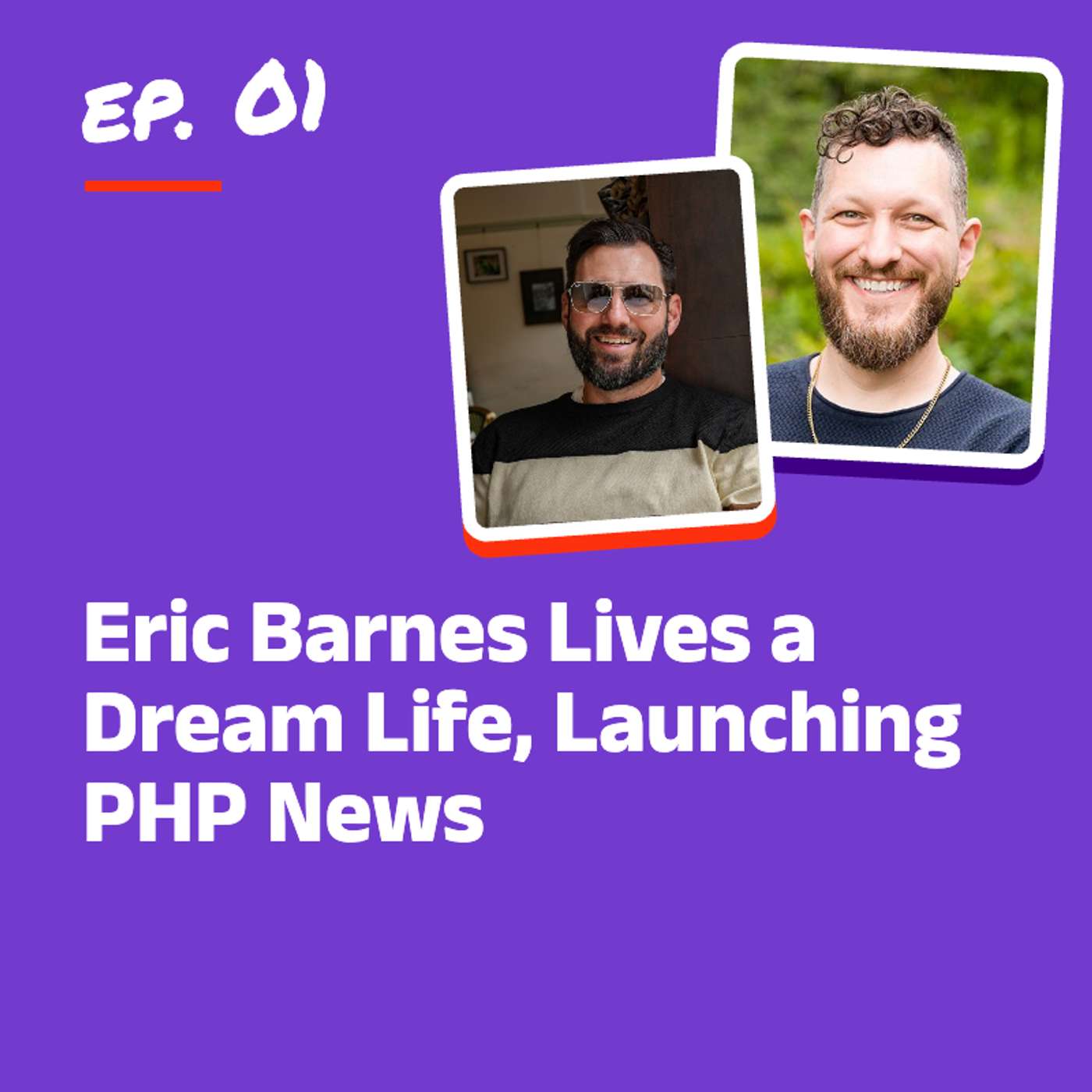
Eric Barnes Lives a Dream Life, Launching PHP News
Matt Stauffer kicks off Season 8 of The Laravel Podcast with longtime friend Eric Barnes, creator of Laravel News, in a wide-ranging conversation that wanders well beyond code.They talk about how Eric learned sales on a motorcycle dealership floor, running a business with Profit First, and how Laravel News is changing now that AI has taken away search traffic. Eric argues that editorial curation still matters. They also announce their new project, PHPNews , and Matt makes the case that PHP is the best ecosystem for LLM-driven development.Along the way, they dig into building a low-stress life, celebrating your wins, and why success really comes down to time. Matt Stauffer on X - https://x.com/mattstaufferEric Barnes's Website - https://ericlbarnes.com/Laravel News - https://laravel-news.com/2020 Episode with Eric Barnes - https://laravelpodcast.com/episodes/learning-keeping-up-to-date-with-eric-barnesEames Lounge Chair - https://www.eamesoffice.com/product/eames-lounge-chair-and-ottoman/Profit First Book - https://mikemichalowicz.com/profit-first/YNAB - https://www.ynab.com/PHP News - https://phpnews.net/Laravel Twitter - https://twitter.com/laravelLaravel Website - https://laravel.com/Tighten Website - https://tighten.com/----- Editing and transcription sponsored by Tighten - https://tighten.com/Big thanks to the companies that support the show:Flare by Spatie - http://flareapp.io and Performance Monitoring - http://flareapp.io/performance-monitoringSerpAPI - https://serpapi.com?utm_source=laravel_podcast
Oct 13, 2026
·
1h 17m 42s
153: 13 Billion Tokens
Ian and Aaron discuss Ian's trip to NYC to see the Amp crew, Aaron's weekend getaway, fighting online with Jesse Bentley, and craziest of all - should Ian 'Laravel New' Outro?Sponsored by Svix, Bento, PostShiba, Laracon AU, and Typesense.Interested in sponsoring Mostly Technical? Head to https://mostlytechnical.com/sponsor to learn more.(00:00) - Rocks In The Stream
(16:15) - Orbin In Person
(24:54) - Aaron's First Internet Business
(40:42) - Giant Buttons
(43:49) - Jesse & Ian Are Fighting
(52:54) - Operation Double
(01:05:23) - 'Laravel New' Outro?
(01:11:18) - Resets
Links:Broken Bow, OklahomaAmp & OrbsIan’s Orbin shirtDaybreakThesis: 2027 (Every)acct229.comacct2031.comLaravel Cloud CLIJesse’s tweet on pricingJason Cohen’s video on raising pricesAntoine’s tweet on Fernand cancellationsHelpSpot
Oct 8, 2026
PHP Foundation Community Hour Podcast 2026.10.08
PHP Foundation Community Hour – October 8, 2026
Hosts: Elizabeth Barron & James Titcumb
James tells the story of how he fell into open source, breaks down what Pi actually does, celebrates the 1.5 release, and shares real advice for anyone nervous about making their first contribution.
How James Got Into Open Source
James traced his open source journey back many years to a set of Zend Framework 1 helper classes he found useful enough to publish, back when he wasn’t even sure GitHub existed yet. From there he built a little tool to deploy code from Git over SSH at a previous employer, replacing a hand-upload process that he knew had to be modernized.
Things really took off when he joined Roave, where contributing was actively encouraged and he was surrounded by prolific maintainers like Marco working on Doctrine, alongside in-house libraries such as Security Advisories and Better Reflection. Having a supportive employer early on made all the difference, letting him do the work during the day instead of squeezing it into nights and weekends.
Elizabeth reflected that this is a common on-ramp into open source: scratch your own itch, put it out there, and hope it helps someone with the same problem. She emphasized how much employer support, team mentorship, and a genuine culture of open source help newcomers find their footing.
What Pi Is and Why It Exists
James explained that Pi came about because the infrastructure around PECL and PEAR is simply aging, with very few people who know the code base well enough to maintain it. The PHP Foundation approached him to overhaul that tooling, applying the hard-won lessons of Composer — which he agrees is arguably the best package manager for any language.
Under the hood, Pi is really a very fancy wrapper around four commands — phpize, configure, make, and make install — plus a lot of dependency management and making sure you get the right package for your specific PHP install, something PECL never really did. Thanks to the Packagist team setting up an extensions area, Pi plugs into Composer’s source code to get that dependency resolution for free.
A key distinction is that you aren’t installing extensions for a project the way you do with Composer packages — you’re installing them for a particular PHP install. Pi manages this in a dedicated Pi home directory, keeping each of your many PHP versions and their extensions sorted out. James’s bigger goal has evolved from simply replacing PECL to making installing an extension as frictionless as installing a PHP package.
Democratizing Extensions and the Windows Challenge
Moving off PECL’s centralized repository and onto Packagist means literally anyone can now submit an extension, the same way they publish PHP packages. James noted that when problems come up there are usually three kinds of fixes: improving something in Pi, writing better documentation, or working with an extension author who hasn’t configured their composer.json correctly.
Because extensions have unique needs, the Composer team added new Pi-specific options to specify configure flags, supported platforms, and architectures — concepts Composer never had since it only ever dealt with pure PHP code. A Windows-only library extension is useless on macOS or Linux, and a systemd-dependent one is useless on Windows, so that categorization matters.
The most common friction point James sees is Windows extensions. Unlike PECL, which auto-compiled DLLs from uploaded source, the Pi ecosystem requires authors to build the DLL themselves — handled through a GitHub Action called PHP Windows Builder, which Shivam worked on. For security reasons Pi deliberately can’t just download and run arbitrary binaries on people’s systems.
The 1.5 Release
Elizabeth congratulated James on shipping 1.5, a significant release that pulled together several large, closely-related requests. A lot of it grew from working with the author of the mlocati Docker PHP extension installer, mapping out everything Pi does on a whiteboard to see where changes could unlock multiple features at once.
The big internal change was fixing how Pi handles locking, bringing it much closer to how Composer manages its own lock file. That one improvement enabled installing multiple extensions at once, making a reinstall of an already-installed extension a no-op, installing reproducibly from a lock file, and the long-requested Pi upgrade command that bumps all your Pi extensions in one go.
The other massive chunk of work was the attestation library. It started as a bare-bones OpenSSL-based verification of GitHub attestation certificates — written with help from Tim Düsterhus so people could verify Pi’s authenticity without needing the gh CLI. For 1.5, James ran it against the Sigstore conformance test suite and filled in a huge number of gaps, bringing it close to full conformance on the verification side. That opens the door to the Composer team’s stated interest in authenticating PHP packages down the line.
Advice for New Contributors
Asked what he’d tell his past self, James kept it simple: just get involved, and always assume good intent. If a maintainer doesn’t respond within a day they’re probably just busy — not ignoring you — and lengthy back-and-forth on a pull request usually reflects a maintainer trying to keep the project maintainable, not nitpicking.
He encouraged everyone to open a discussion before sending a PR so effort doesn’t get duplicated — a lesson learned after early contributions collided with work he already had in progress. To help with that, he adds a “maintainer investigating” label to issues he’s actively working on, and leans on issue and PR templates to steer people in the right direction.
Elizabeth added that newer coders can find it intimidating to put their work out publicly on GitHub forever, and that both sides benefit from a little grace and a shared social contract. James closed by stressing that the single most helpful contribution is feedback — report even the small things you worked around, because eliminating that friction saves the next developer the same headache, as happened with a recent PCRE2 compile fix on macOS.
Links from the show:
Pi (php/pie) — GitHub repository, issues & discussions
PHP Windows Builder GitHub Action
Packagist Extensions
Composer
attestation library
Introduction to PIE
Host:
Elizabeth Barron
Mastodon: @[email protected]
LinkedIn: elizabethn
James Titcumb
Mastodon: @[email protected]
Streams:
Youtube Channel
Twitch
Connect & Hire
PHP Architect Website
Twitter/X
Mastodon
Hire PHP Developers
Looking to hire PHP developers? Email [email protected] – Joe and the team are available for consulting, infrastructure work, Ansible playbooks, and code review.
Music Provided by Epidemic Sound
https://www.epidemicsound.com/
Join Us Live Next Week
Youtube Channel
Got feedback? Join us on Discord at discord.phparch.com
The post PHP Foundation Community Hour Podcast 2026.10.08 appeared first on PHP Architect.
Oct 8, 2026
·
45m 3s
Memoized Caches, Building a Social Network, and Classification
Jake and Michael discuss all the latest Laravel releases, tutorials, and happenings in the community.This episode is sponsored by PostShiba - the transactional email platform that powers Bento's amazing delivery rates. Join the waitlist at PostShiba.com.Show linksTagged Memoized Cache and Model Refreshes in Laravel 13.33Count Worker Crashes as Job Exceptions in Laravel 13.34WhenMounted and BigInt Props in Inertia.js v3.8Live Stream: Building a Social Network in PHP in 48 HoursLaravel Live Denmark 2026 Talks Are Now on YouTubeLaravel AI SDK 1.0 Adds Classification and Tool ApprovalsJetBrains Air: Run AI Coding Agents in JetBrains IDEsLaravel Release Cycle: Versions, Support Policy, and DatesLaravel AI SDK and Laravel MCP Security Fixes: Update NowLaravel 14 Adds a defaults() Method to Eloquent ModelsSecuring Filament plugins with PlumbFast Excel 5.x Adds Streaming Imports and Safer ExportsHealth for Laravel: Kubernetes Probes and Prometheus MetricsTashil: Laravel Subscription Plans and Feature Usage LimitsElastic Bridge: Eloquent-Style Queries for Elasticsearch and OpenSearchMailbox for Laravel: Preview and Test Rendered EmailPostcodes for Laravel: GB Postcode Lookup and Geography DataLayaPHP: Self-Hosted Text Classification for PHP and LaravelTutorialsMemoize Tagged Cache Reads in LaravelDecide with Jev: Laravel AI That Answers with a Probability
Oct 7, 2026
Community Corner Podcast: This Week in PHP Internals with Len Woodward
In this episode, Scott talks Len Woodward about This Week in PHP Internals and the state of the PHP Internals world.
Links:
Our Discord – https://discord.gg/aMTxunVx
Buy our shirts – https://store.phparch.com/products/community-corner-podcast-t-shirt
Len’s Links:
X / Twitter: @ProjektGopher — https://x.com/ProjektGopher
Bluesky: @projektgopher.com — https://bsky.app/profile/projektgopher.com
Mastodon: @[email protected] — https://phpc.social/@ProjektGopher
Threads: @projektgopher — https://www.threads.com/@projektgopher
Instagram: @projektgopher — https://www.instagram.com/projektgopher/
LinkedIn: https://www.linkedin.com/in/projektgopher/
Pinkary: @ProjektGopher — https://pinkary.com/@ProjektGopher
Reddit: @ProjektGopher — https://www.reddit.com/user/ProjektGopher/
Dev.to: @projektgopher — https://dev.to/projektgopher
YouTube: @ArtisanBuild — https://www.youtube.com/@ArtisanBuild
Show: This Week in PHP Internals — https://www.youtube.com/@ArtisanBuild
Company: Artisan Build — https://artisan.build
Scott’s Links:
Website – https://scott.keck-warren.com/
Bluesky – https://bsky.app/profile/scottkeckwarren.bsky.social
LinkedIn – https://www.linkedin.com/in/scott-keck-warren-91689810/
Mastodon – https://phpc.social/@scottkeckwarren
PHP Architect Social Media:
X: https://x.com/phparch
Mastodon: https://phparch.social/@phparch
Bluesky: https://bsky.app/profile/phparch.com
Discord: https://discord.phparch.com
Subscribe to our magazine: https://www.phparch.com/subscribe/
Partners
This podcast is made a little better thanks to our partners.
OurCVEs
Your security posture, on autopilot with OurCVEs
CodeRabbit
Cut code review time & bugs in half instantly with CodeRabbit.
PHP Architect Consulting
Your PHP codebase deserves a partner, not a contractor
PHP Architect provides long-term technical partnerships for organizations that need senior-level PHP expertise that you can depend on
https://www.phparch.com/consulting/
Music provided by Epidemic Sound https://www.epidemicsound.com/
#phpc #php #communityCornerPodcast #podcast #phptek
The post Community Corner Podcast: This Week in PHP Internals with Len Woodward appeared first on PHP Architect.
Oct 7, 2026
·
11m 34s
What makes a man
Oct 7, 2026
·
15m 45s
WHAT DID YOU EXPECT!
Oct 6, 2026
·
18m 38s
Business is Catan (and im building something new)
Oct 6, 2026
·
1h 17m 23s
152: Feel The AGI
Ian and Aaron discuss OpenAI's Dots, Aaron's trip to Denver, working with tests in the AI era, big things coming to Laravel, and a whole lot more.Sponsored by Svix, Bento, PostShiba, SerpAPI, Laracon AU, and Typesense.Interested in sponsoring Mostly Technical? Head to https://mostlytechnical.com/sponsor to learn more.(00:00) - America, Coke Zero
(07:14) - Aaron Went To Denver
(09:58) - Big Things Coming To Laravel
(18:46) - The Milwaukee Brewers
(26:41) - A Reverse Epiphany
(37:15) - Mini Motorways
(46:45) - Dot & AI Agents
(01:03:14) - Can AI Companies Make Money?
(01:09:49) - Tests
Links:America Coke Zero videoLaravel New videoAll-In PodcastRogue AmoebaLaravel NewsName.comMilwaukee BrewersMini MotorwaysDot by OpenAIPest Browser Testing